Software has a significant impact on how users interact with smartphones, and the business is always changing. According to recent reports, OnePlus and Realme may eventually abandon their proprietary Android skins, OxygenOS and Realme UI, in favour of a more unified software platform. The rumours have generated conversations among smartphone fans worldwide, even though neither company has formally acknowledged a complete discontinuance.
While Realme UI has been well-known for providing a feature-rich experience at reasonable costs, OxygenOS has long been commended for its simple and quick interface. If these rumours are accurate, it might be one of the largest changes to Android’s OS.
This essay will explain the reasons for these changes, their possible advantages and disadvantages, and what users might anticipate in the years to come.
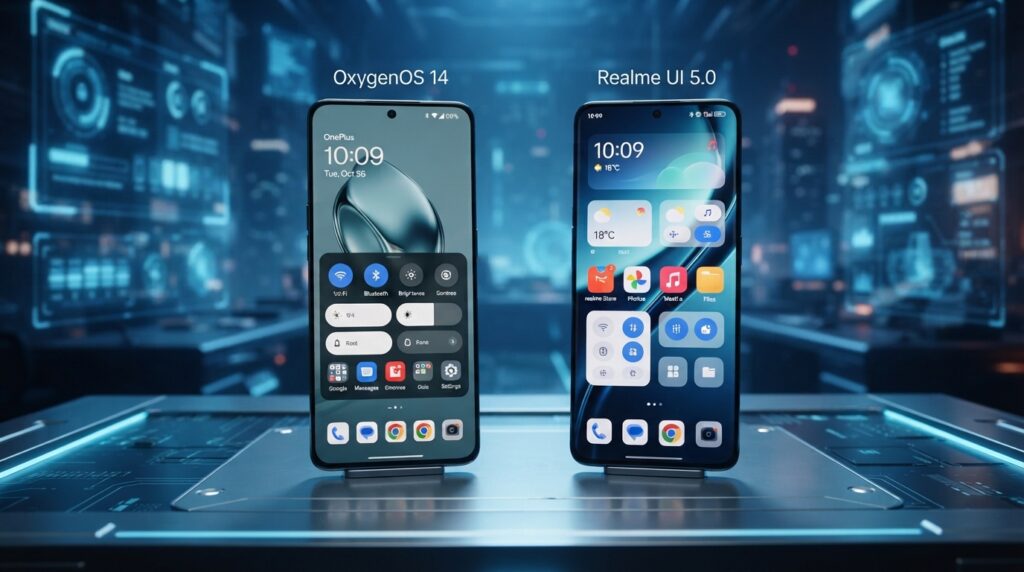
The Development of Realme UI and OxygenOS
OxygenOS was first released as a lightweight Android skin with an emphasis on low bloatware, speed, and simplicity. Because it added practical customisation features while remaining near to stock Android, it soon became one of the most popular Android interfaces.
Conversely, Realme UI was created to offer a balance between customisation and performance. Built on Android, it attracted younger users with its vibrant themes, gaming facilities, privacy options, and battery optimisation.
Due to their common development experience, both interfaces have grown more alike over time.
Why Are Realme and OnePlus Allegedly Changing This?
Software unification may help both businesses increase productivity and expedite development, according to a number of industry surveys.
Among the potential causes are:
Quicker updates for Android
Simpler upkeep of software
Lower development expenses
Improved interoperability across devices
Development of shared features
Enhanced deployment of security patches
Developers can concentrate on enhancing a single, cohesive software experience rather than maintaining several operating systems independently.
What Could Take the Place of Realme UI and OxygenOS?
Despite the lack of a formal declaration, experts speculate that the companies might keep incorporating further features from their parent ecosystem.
Future software may include:
Unified language for design
Features of shared AI
Improved cloud integration
More intelligent battery management
Advanced privacy safeguards
Improved gaming optimisation
Ecosystem connectedness that is seamless
Users won’t necessarily lose customisation as a result of this. Rather, the UI might become more uniform on various devices.
Possible Advantages for Users
Users may benefit from a number of enhancements if the software transition is handled well.
- Quicker Updates for Software
Updates for Android can be released more quickly if a single software platform is managed.
Users could get:
Faster versions of Android
Security patches every month
Fixes for bugs
Improvements in performance
- Increased Stability
Instead of maintaining several interfaces, developers may devote more attention to speed optimisation with a unified software system.
Advantages could consist of:
Reduced insects
Improved RAM control
Enhanced battery performance
More fluid animations
- Improved AI Features
Smartphones are increasingly incorporating artificial intelligence.
Updates in the future could include:
AI-powered photo editing
Optimising smart batteries
Enhancements to AI voice assistants
Managing apps intelligently
- Simpler Integration of Ecosystems
A common operating system could enhance communication between:
Tablets and smartphones
Earbuds and smartwatches
Intelligent televisions
Users might benefit from improved cross-device functionality and quicker syncing.
Potential Difficulties
Software unification provides advantages, but it also brings up a number of issues.
Loss of Identity
Simplicity was the foundation of OxygenOS’s reputation.
Many people are concerned that software may become less distinctive if it is combined.
Curve of Learning
Current interface layouts and settings are already known to current users.
Users of a modified operating system might need to adjust to:
New menus
Various configurations
Revised navigation
Additional personalisation choices
Problems with Compatibility
Occasionally, significant software changes bring about:
Issues with app compatibility
Small bugs
Battery drain Variations in performance
Later upgrades typically resolve these problems.
What Effects Might This Have on Current Users?
Current OnePlus and Realme owners are unlikely to lose support immediately.
Rather, it is anticipated that the shift, if it occurs, will occur gradually.
Users may continue receiving:
Updates on security
Android upgrades Bug fixes
Until the end of their software support period, older devices could have their current interface.
Impact on Future Smartphones
Upcoming smartphones could launch with a redesigned operating system featuring:
Better animations
AI-powered customization
Improved multitasking
Smarter notification management
Enhanced privacy controls
Manufacturers are increasingly focusing on AI-powered experiences rather than only hardware upgrades.
What Is the Difference Between This and Other Android Brands?
A number of Android manufacturers have already simplified their software development processes.
Examples consist of:
The One UI from Samsung
HyperOS from Xiaomi, Nothing OS, and Motorola Hello UI
Rather than maintaining several separate systems, these organisations keep improving a single software platform.
OnePlus and Realme’s claimed action is in line with a similar industry trend toward software efficiency.
Do Users Need to Be Wary?
At this stage, users have little reason to worry
Software advances continuously, and organisations regularly rethink user interfaces to increase security, performance, and functionality.
If Realme and OnePlus offer:
Easy updates
Consistent performance
Excellent personalisation
Long-term assistance
The majority of users are probably going to adjust fast.
But devoted OxygenOS lovers might still regret its understated style.
Benefits and Drawbacks
✏ Quicker Android updates
Improved software optimisation
✏ Better security updates
◦ Improved AI capabilities
Easier integration of ecosystems
✏ Less software errors
✔ Better long-term maintenance
Drawbacks
✖ Possible loss of OxygenOS identity
✖ Learning curve for existing users
✖ Early software errors
✖ Interface modifications may not appeal to everyone
✖ Older devices may acquire fewer new features
FAQ
Is OxygenOS shutting down?
The discontinuation of OxygenOS has not yet been formally confirmed. Future software may be more integrated with a single platform, according to reports.
Will updates be discontinued for current OnePlus phones?
No, it is anticipated that current devices will continue to get security and software updates in accordance with their approved maintenance schedule.
Is Realme UI disappearing?
The full removal of Realme UI has not been formally announced. Instead of an abrupt cessation, the reports suggest software integration.
After the software change, will users lose their data?
Personal information is typically not deleted by software updates. However, it is always advised to make a backup before installing any significant updates.
Will software unification lead to an improvement in performance?
Users may benefit from better optimisation, longer battery life, quicker updates, and more seamless performance provided the implementation is done correctly.
When will these software modifications take place?
A formal timeline has not been disclosed. It is anticipated that any significant software modifications would be released gradually through upcoming Android releases.
In conclusion
Android users are very interested in reports that OnePlus and Realme may phase out OxygenOS and Realme UI. The possible action represents a larger trend toward software unity throughout the smartphone industry, even though official confirmation is still pending.
Faster upgrades, more robust security, enhanced AI capabilities, and a more interconnected environment may all be provided by a single operating system. But it can also make people worry about losing the distinctive character that initially made Realme UI and OxygenOS so well-liked.
In the end, how successfully the businesses strike a balance between innovation and the user experience that devoted customers have grown to value will determine how successful this shift is. Users should consider these stories to be conjecture until formal announcements are made, and they should keep a watch out for upcoming software updates and product releases.