Smartphones are become a necessary component of everyday life. Modern gadgets perform more jobs than ever before, from shooting high-resolution pictures and making 4K films to playing graphic-intensive games and utilising AI-powered apps. While cameras and processors keep getting better every year, one problem that people are experiencing more frequently is the memory crisis on smartphones.
Even with relatively new smartphones, a lot of folks have trouble installing updates, poor performance, storage full notifications, and app crashes. Budget phones are not the only ones with this rising issue. As apps get bigger and digital information takes up more space, premium smartphones are increasingly having trouble managing their storage.
Users may manage their gadgets more effectively and make better purchasing decisions if they understand the reasons behind this memory problem. It also clarifies why smartphone makers are making significant investments in cloud-based solutions, quicker memory technology, and greater storage capabilities.
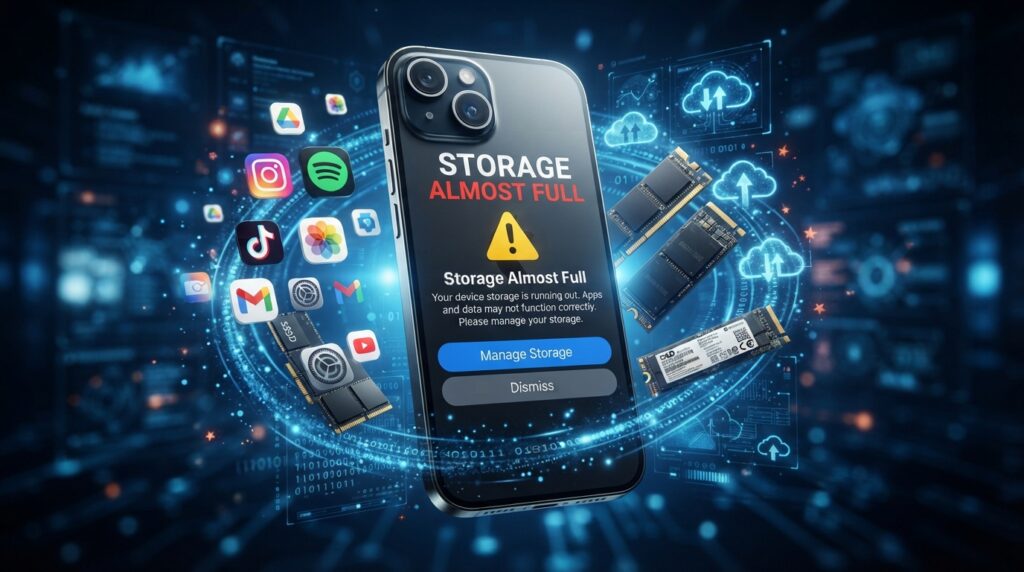
The Smartphone Memory Crisis: What Is It?
The growing discrepancy between the amount of Memory Crisis on smartphones and the amount of memory needed by contemporary operating systems, media files, and applications is known as the “smartphone memory crisis.”
Mobile apps get more sophisticated every year. High-quality videos are now supported by social networking networks, games frequently need several gigabytes of storage, and messaging apps instantly download media assets. Smartphone cameras simultaneously take incredibly high-resolution pictures and films that take up a lot of storage space.
Because of this, a lot of customers discover that their gadgets run out of memory more sooner than anticipated.
This problem impacts both:
RAM (Random Access Memory) is internal storage.
Despite having separate functions, these two elements have an impact on the whole smartphone experience.
Recognising the Distinction Between RAM and Storage
RAM and internal storage are often confused by smartphone users. Despite being types of memory, they serve quite distinct purposes.
RAM
Information is momentarily stored in RAM while programs are operating. It makes it possible for consumers to quickly move between several programs.
Increased RAM implies:
Improved multitasking
Quicker app switching
Enhanced performance in games
Decreased reloads of applications
Internal Storage
Internal storage keeps the following permanently:
Images, Videos, Applications, and Documents
System files for music
Users may encounter the following when storage fills up:
Reduced efficiency
Software updates that didn’t work
Limitations of camera recording
Installing new apps is difficult.
RAM and storage are both essential for a seamless smartphone experience.
The Reasons Behind the Worsening Memory Crisis
The increasing memory issue in today’s smartphone market has been caused by a number of issues.
- Bigger Mobile Apps
Applications today are far more extensive than they were a few years ago.
Updates for well-known apps frequently include:
New attributes
AI instruments
Improved visuals
Increased safety
Content that is not online
Applications’ storage needs grow dramatically as they develop.
For instance, after downloading extra content, games now frequently need several gigabytes of storage.
- Cameras with High Resolution
The cameras on smartphones have significantly improved.
These days, a lot of flagship gadgets provide:
108MP and 50MP cameras
200MP cameras
4K video capture
8K video capture
RAW images
Although these characteristics create beautiful photographs, they also result in substantially greater file sizes.
Professional RAW shots need a lot more storage than regular JPEG images, and a minute of 4K video might take up hundreds of megabytes.
- AI Features Need More Memory
Modern smartphones are starting to come equipped with artificial intelligence.
AI capabilities:
Enhancement of photos
Voice assistants
Translation of languages in real time
Astute search
Writing support
creation of images
For these sophisticated features to work well, more RAM and storage are needed.
Memory requirements keep rising as AI gets more complex.
- Operating Systems Are Getting Bigger
Every year, updates for iOS and Android bring new features.
These updates increase functionality and security, but they also take up more storage.
Before any personal data are added, many users are shocked to learn that the operating system takes up a sizable amount of their phone’s internal storage.
How Smartphone Users Are Affected by the Memory Crisis
The user experience is directly impacted by a number of issues caused by limited memory.
Reduced Performance
Smartphones frequently have trouble carrying out standard tasks when storage is almost full.
Users might observe:
App launches that are slow
Touch responses that are delayed
Freezing screens
Extended boot durations
Regular “Storage Full” Alerts
Many consumers receive alerts about their storage being depleted on a regular basis.
Because they interfere with regular phone use and frequently force users to erase important files, these notifications become annoying.
Issues with Software Updates
Before installation, operating system upgrades need free storage.
Users could have to delete apps, pictures, or movies in order to apply security upgrades if there isn’t enough room.
Diminished Camera Performance
A full gadget is unable to take more pictures or movies.
When consumers need their cameras the most—during vacations, family gatherings, or significant events—this issue usually arises.
A bad gaming experience
RAM and storage are crucial components of contemporary mobile games.
Inadequate memory may result in:
Frame drops
Slow loading speeds
Unexpected collisions
Diminished visual quality
One of the first people to detect memory issues is frequently a gamer.
How Manufacturers of Smartphones Are Reacting
These increasing memory issues are being actively addressed by the smartphone industry.
These days, a lot of manufacturers provide devices with:
The default internal storage capacity is 256GB.
512GB and 1TB high-end versions
Quicker UFS storage technology
RAM for LPDDR5 and LPDDR5X
AI-driven memory optimisation
Features for virtual RAM extension
These enhancements enable smartphones to handle demanding apps more effectively while giving users greater media and file storage.
But expanding storage capacity is insufficient on its own. Manufacturers must concentrate on more intelligent memory management technologies and improved software optimisation as apps and digital content continue to expand.
Cloud Storage: Another Problem or a Workable Solution?
One of the most widely used solutions for smartphones with limited capacity is cloud storage. Users can upload their files to cloud services and access them at any time rather than keeping all of their images, videos, and documents on the device itself.
By enabling users to automatically backup their data, popular cloud systems lessen the strain on internal storage. Those who often record high-quality films or take thousands of pictures will find this method very helpful.
Cloud storage isn’t a great option, though. The majority of services only provide a certain amount of free storage; once that amount is reached, users must buy a membership. Additionally, a reliable internet connection—which might not always be available—is necessary to access cloud data. Relying only on cloud storage can be troublesome for consumers who live in places with expensive or slow internet.
Because of this, a lot of smartphone owners combine cloud backups with local storage to get the greatest possible balance between performance and convenience.
The Memory of Smartphones in the Future
New technologies that enhance memory performance and storage capacity are still being developed by the smartphone industry.
Future smartphones are anticipated to have the following features:
Apps load more quickly because to faster UFS storage technologies.
LPDDR RAM with increased efficiency for more seamless multitasking.
AI-driven memory management that optimises storage automatically.
greater default storage capacities—256GB is now the norm for many devices.
enhanced cloud connectivity for smooth file syncing.
Improved file compression techniques to use less storage without sacrificing quality.
These developments will enable smartphones to run quickly while handling more complex apps, AI functions, and high-resolution video
How to Effectively Manage Smartphone Memory
Although hardware upgrades are crucial, users can avoid storage-related problems in a number of ways.
Get Rid of Unused Applications
Installing apps that they hardly ever use is common. Eliminating pointless apps can enhance device performance and free up important storage space right away.
Delete Cache Files
To improve performance, applications generate temporary cache files. These files may take up several gigabytes of storage over time. Periodically clearing the cache aids in space recovery without erasing private information.
Backup Images and Videos
The majority of a smartphone’s capacity is typically made up of photos and movies. Transferring older files to an external drive or online storage keeps the device snappy and well-organised.
Eliminate Duplicate Files
Users frequently become unaware of the accumulation of duplicate images, screenshots, and downloaded documents. Significant storage can be recovered by routinely removing duplicate files.
Update Apps Frequently
Performance enhancements and storage optimisations are frequently included in app upgrades. Applications operate effectively and safely when they are kept up to date.
Keep an eye on storage use
The majority of smartphones come with built-in storage analysis tools. Before memory becomes a major issue, users can find huge files and superfluous data by routinely reviewing storage utilisation.
What Is Your Required RAM and Storage Capacity?
Your usage habits play a major role in selecting the best smartphone. Purchasing a gadget with inadequate RAM can quickly cause performance problems.
Informal Users
If you primarily utilise your phone for:
Making a call and sending messages
Social media and web browsing
In most cases, a smartphone with 128GB of storage and 6GB of RAM is adequate.
Typical Users
For users who regularly:
Take pictures
View videos
Install a lot of programs
Engage in moderate multitasking
It is more comfortable to use a gadget with 256GB of storage and 8GB of RAM.
Gamers and Power Users
If you
Play challenging mobile games
Make 4K videos.
Modify images or videos
Utilise AI-driven apps
A smartphone with 512GB or more of storage and 12GB or more of RAM is a superior long-term investment.
A smartphone’s lifespan and general usability can be greatly increased by choosing the right memory configuration.
In conclusion
One of the major issues facing the mobile industry is the memory crisis in smartphones. The need for RAM and internal storage keeps rising as applications get bigger, cameras capture better material, and AI-powered capabilities proliferate.
In response, manufacturers are providing quicker memory technology, more storage options, and clever software optimisation. Users do, however, also have a significant impact through prudent storage management, the removal of superfluous information, and the judicious use of cloud services.
Memory should be taken into consideration when buying a new smartphone, much like the processor or camera. A longer-lasting gadget, improved multitasking, and smoother performance can all be achieved by investing in enough RAM and storage now.
FAQ
- What is the memory crisis on smartphones?
The growing lack of RAM and storage on smartphones brought on by larger apps, high-resolution media files, and more sophisticated operating systems is known as the “smartphone memory crisis.”
- Why does the storage on my smartphone fill up so fast?
Large apps, images, movies, downloaded files, cached data, and system updates that eventually need more space cause storage to fill up.
- Is RAM more crucial than storage?
Both play distinct yet equally important roles in a smartphone. Internal storage determines how much content—such as apps, photos, videos, and documents—you can save, while RAM ensures smoother multitasking and faster app performance.
- Can internal storage be replaced by cloud storage?
Because many programs and system files must stay on the device, cloud storage can help free up space but cannot fully replace local storage.
- How can I increase the memory on my smartphone?
Unused programs can be removed, cache files can be cleared, duplicate media can be eliminated, images can be backed up, and storage usage can be routinely tracked.
- What is the suggested storage capacity for a brand-new smartphone?
For most smartphone users, 256GB of internal storage offers enough space for everyday needs while remaining suitable for future requirements. Those who frequently store large files or create high-resolution content should consider 512GB or more.
- Will the memory crisis be resolved by upcoming smartphones?
Although higher storage capacity, quicker memory technologies, and more intelligent AI-based memory management will be available on future devices, memory demands will still rise due to expanding app sizes.