The iPhone vs. Samsung debate is more difficult than ever if you are purchasing a new smartphone primarily for gaming. Strong CPUs, high-refresh-rate screens, sophisticated cooling systems, extended battery life, and access to challenging mobile games are all features of both brands.
However, benchmark scores are only one aspect of gaming.
A great gaming phone should be able to control heat, maintain performance over extended periods of time, have a responsive display, have a long battery life, and allow you to access the games and accessories you really want to use.
The competition between Samsung’s Galaxy S26 Ultra and Apple’s iPhone 17 Pro and iPhone 17 Pro Max is particularly intriguing for US consumers in 2026. The A19 Pro chip and a specialised vapour chamber are used in Apple’s iPhone 17 Pro series to provide better long-term performance. A modified Snapdragon 8 Elite Gen 5 for Galaxy and an improved vapor-chamber cooling mechanism are used in Samsung’s Galaxy S26 Ultra. Additionally, both phones have displays with a refresh rate of up to 120 Hz.
Which is better for gaming, then?
The iPhone 17 Pro Max is a superior option for the majority of dedicated mobile gamers if access to top-notch premium games and optimised gaming performance are your top priorities. If you’re looking for a bigger screen, Android flexibility, quick charging, and gaming-specific hardware capabilities, the Samsung Galaxy S26 Ultra is a better option.
Let’s examine the distinctions.
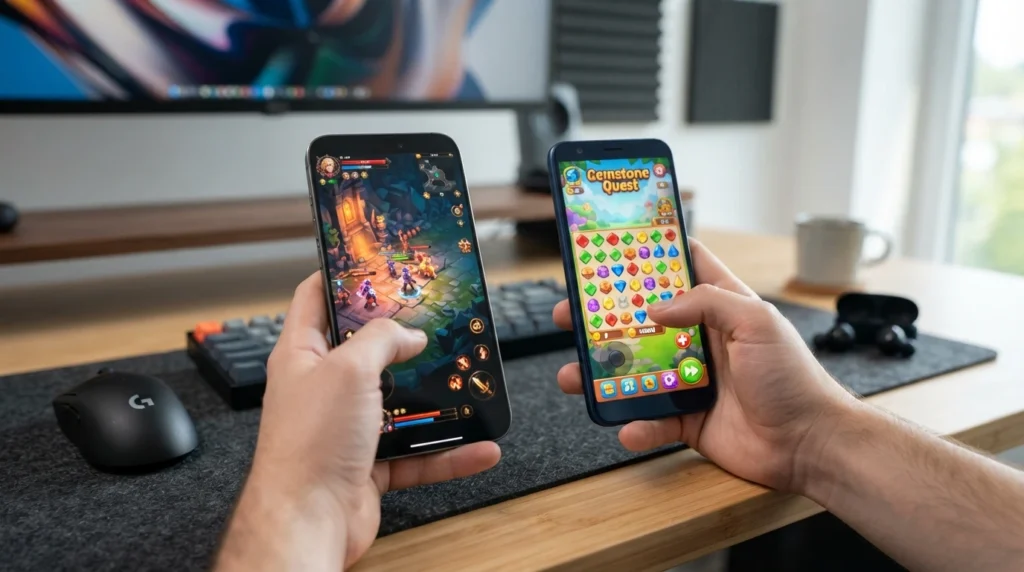
iPhone vs Samsung for Gaming: Quick Verdict
Before getting into the details, here’s the short version:
| Gaming Feature | iPhone 17 Pro Max | Galaxy S26 Ultra |
|---|---|---|
| Gaming Performance | Excellent | Excellent |
| Processor | A19 Pro | Snapdragon 8 Elite Gen 5 for Galaxy |
| Display | 6.9-inch, up to 120Hz | 6.9-inch, 120Hz |
| Cooling | Vapor chamber | Enhanced vapor chamber |
| Battery | Excellent | 5,000mAh |
| Charging | Fast | Faster |
| Game Optimization | Excellent | Excellent |
| Android Flexibility | No | Yes |
| Premium Game Selection | Excellent | Excellent |
| Gaming Accessories | Good | Excellent |
| Best For | Performance-focused gamers | Flexible Android gamers |
The fact that there isn’t a single winner for every kind of gamer is crucial.
The iPhone is quite hard to match if you want a phone that just launches a game and provides a consistently polished experience.
Samsung presents a compelling argument if you choose Android, a larger ecosystem of gaming accessories, customisation, multitasking, and quicker charging.
iPhone vs. Samsung Gaming Performance
Gamers typically focus on raw performance first, and both phones are incredibly potent.
The iPhone 17 Pro and Pro Max are driven by Apple’s A19 Pro processor, delivering the high-end performance needed for demanding tasks and gaming.
The CPU and its thermal architecture are especially positioned by Apple to support demanding workloads, such as sophisticated gaming. According to the business, under its specified testing settings, the A19 Pro, GPU, and enhanced thermal design can provide up to 40% greater sustained performance than the previous generation.
With the Galaxy S26 Ultra, Samsung adopts a different strategy.
A specially designed Snapdragon 8 Elite Gen 5 for Galaxy chipset powers the phone. Additionally, Samsung claims to have improved thermal performance by 21% by upgrading its cooling system with a new vapour chamber and thermal interface material. In particular, the business emphasises ray tracing capabilities, Vulkan optimisation, and challenging games.
Both phones offer more than enough processing power to play popular games on a daily basis.
The hardware in these flagship phones may be utilised by demanding games like Call of Duty: Mobile, PUBG Mobile, Fortnite, Genshin Impact, Diablo Immortal, and others.
Which performs better in games?
For gamers who value reliable performance and highly optimised game releases, the iPhone has an advantage.
For gamers seeking Android-specific capabilities and graphics technologies like Vulkan and hardware-supported ray tracing in compatible games, Samsung has an advantage.
To put it another way, Samsung is the more versatile gaming platform, but the iPhone is the safer performance-first option.
Display: Is There a Better Phone for Gaming?
In mobile gaming, a high-quality display can have a significant impact.
The Galaxy S26 Ultra and iPhone 17 Pro Max both have big screens with refresh rates of up to 120 Hz. While Samsung’s Galaxy S26 range employs an adaptive 120Hz display system, Apple’s ProMotion technology dynamically modifies the refresh rate.
Compared to a conventional 60Hz screen, a 120Hz display can make animations and camera movement appear substantially better for fast-paced games.
This is crucial in sports games, racing games, competitive shooters, and other games where fast reflexes are crucial.
The Galaxy S26 Ultra comes with a spacious 6.9-inch QHD+ Dynamic AMOLED 2X screen, designed to deliver sharp details and vibrant visuals. Samsung also states that the display can reach a peak brightness of 2,600 nits, making it easier to view content even in bright outdoor conditions.
On the other hand, the iPhone 17 Pro Max features a 6.9-inch OLED panel with Apple’s ProMotion technology, supporting refresh rates of up to 120Hz. Apple also rates the display for up to 3,000 nits of peak outdoor brightness, giving users excellent visibility in direct sunlight.
Winner of the display: tie, with varying strengths
If you value Android’s huge, high-resolution display and customisation, the Galaxy S26 Ultra is especially appealing.
If you desire Apple’s superb colour reproduction, seamless ProMotion experience, and outstanding outdoor visibility, the iPhone 17 Pro Max is a great choice.
Both are excellent for gaming alone.
Heat Control and Extended Gaming Times
One of the most significant distinctions between a high-quality gaming phone and a phone that merely appears good on a benchmark chart is this.
Running demanding games for extended periods can cause a smartphone’s processor to generate considerable heat.
Most modern flagship phones can handle a short gaming session without any major performance issues. However, the real difference becomes noticeable when you continue playing graphically intensive games for 30, 60, or even 90 minutes.
A phone’s processing performance may decrease as it becomes hotter in order to control the temperature. Thermal throttling is the term used to describe this phenomenon.
Apple has improved the thermal design of the iPhone 17 Pro lineup by introducing a vapor chamber cooling system. This setup helps move heat away from the A19 Pro processor and spread it across the phone’s aluminum body, which can help the device maintain performance during demanding workloads.
Samsung has also put significant emphasis on heat management with the Galaxy S26 Ultra. The company says its redesigned vapor chamber, paired with an upgraded thermal interface material, improves thermal performance by 21%. This enhanced cooling system is designed to help the phone handle demanding activities, including extended gaming sessions, more effectively.
Thermal Performance: Too Close to Call
Both Apple and Samsung understand that keeping temperatures under control is essential for maintaining stable performance during long and demanding gaming sessions.
The ideal phone for extended gaming sessions will vary on the particular game, graphical settings, casing, software version, and ambient temperature.
However, these two phones are far more capable than previous flagship models that depended on more straightforward passive cooling if you regularly play demanding games for hours.
Mobile Gaming Battery Life
Due to the simultaneous operation of the CPU, GPU, display, speakers, and wireless radios, gaming can quickly deplete a smartphone’s battery.
With a 5,000mAh battery, Samsung claims that the Galaxy S26 Ultra can play videos for up to 31 hours during testing. Additionally, with the right charging equipment, it can be charged up to 75% in around 30 minutes.
Apple approaches iPhone battery specifications differently, choosing not to prominently disclose the battery capacity in mAh.
Instead, the company focuses on estimated usage figures, including video playback. Apple rates the iPhone 17 Pro Max for up to 39 hours of video playback, although this figure should not be treated as a direct measure of gaming endurance because playing games places different demands on the battery.
For gamers, the speed at which a battery charges might be just as crucial as its overall capacity.
If you frequently forget to charge your phone before a gaming session, Samsung’s quicker charging is very helpful.
Samsung for charging and iPhone for overall effectiveness are the battery winners.
Samsung has an advantage with its fast charging method if you want to get back into a game as soon as possible.
The iPhone is still a great option if you are more concerned with overall battery life and Apple’s well-integrated hardware-software ecosystem.
Optimisation and Game Selection
Hardware doesn’t tell the whole story.
Operating system optimisation is required for the games themselves.
Apple’s tightly controlled hardware ecosystem has always made iOS appealing to mobile game developers. Compared to the vast array of Android devices available globally, developers may focus on a smaller range of current iPhone hardware combinations.
Because of this, iOS may become a desirable platform for high-end graphics experiences and games.
Additionally, Apple has a Game Mode that prioritises gaming performance and responsiveness.
On the other hand, Android offers Samsung consumers a great deal of flexibility.
Samsung’s gaming software and hardware ecosystem offers consumers greater flexibility over settings, accessories, multitasking, and customisation, while the Google Play Store has a vast game library.
You won’t have to choose between an iPhone and a Samsung game for the majority of popular mobile games.
The game’s functionality, the speed at which updates are released, the title’s level of optimisation, and the platform-specific features that are supported are the main areas of difference.
Winner of the game ecosystem: iPhone
The iPhone offers a small advantage for players who need consistent optimisation and premium game releases.
Samsung is still a great choice, particularly for gamers who want greater control over their device and prefer Android.
Ray tracing and graphics
The graphics in mobile games are now quite sophisticated.
Features that were previously virtually exclusively associated with PCs and consoles can now be supported by flagship phones.
The A19 Pro platform of the iPhone 17 Pro is built for demanding graphics workloads, and Apple’s tightly integrated hardware and software significantly enhance the gaming experience.
With its Snapdragon architecture, Samsung’s Galaxy S26 Ultra particularly showcases Vulkan-optimized games and ray tracing capabilities. According to Samsung, ray tracing can provide more lifelike lighting, reflections, and three-dimensional images in games that are compatible.
But there is one crucial thing that gamers should keep in mind:
Only when a feature is supported by the game does it matter.
A phone should never be purchased just because its chipset allows ray tracing. Examine the games you personally play to see if they make use of the functionality.
Gaming Accessories and Controls
Samsung gets very intriguing at this point.
A wide variety of gaming attachments, controllers, cooling fans, triggers, USB-C accessories, and other peripherals are typically available for Android phones.
Connecting different accessories and external devices is also made simple with the Galaxy S26 Ultra’s USB-C connectivity.
Apple consumers are not excluded from engaging in serious mobile gaming because the iPhone also supports gaming controllers and peripherals.
You probably won’t care for casual gaming.
However, accessories can drastically alter the experience of competitive or console-style gameplay.
Racing, action, role-playing, and cloud gaming games can seem a lot more like console games when played with a dedicated controller.
Winner of accessories: Samsung
If you like playing with Android gaming gadgets and customisation, Samsung wins.
Samsung vs. iPhone for Cloud Gaming
The discussion is altered by cloud gaming.
Players can play games remotely and broadcast the video to their phone via services like Xbox Cloud Gaming and other game-streaming systems.
In this case, the following factors are more significant than the phone’s raw GPU performance:
Quality of display
Wi-Fi functionality
5G internet access
Battery life
Support for controllers
Thermal efficiency
stability of the network
Samsung and the iPhone are both capable of playing games on the cloud.
For controller-based cloud gaming, the huge 6.9-inch display of the Galaxy S26 Ultra is great.
The iPhone 17 Pro Max is a potent portable gaming screen due to its huge display and robust wireless connectivity.
Samsung is especially attractive for cloud gaming due to its wider Android ecosystem and flexible accessories, but there isn’t a clear winner.
Gamers’ Software Experience
Many individuals are unaware of how much of an impact the operating system can have.
iOS is renowned for its tidy, well-managed software. Additionally, Apple offers a robust ecosystem, particularly if you already own items like an Apple Watch, Mac, iPad, or AirPods.
Android users have a lot more customisation options thanks to Samsung’s One UI.
You can utilise split-screen capabilities, alter the interface’s look, manage files more freely, and benefit from Android’s increased system flexibility.
Users who wish to have more control over their gaming environment may find Samsung’s software tools appealing.
Winner of software: Depending on the player
If you appreciate consistency, ease of use, and the Apple ecosystem, go with the iPhone.
If customisation, multitasking, and Android independence are more important to you, go with Samsung.
Which Is Better for Gaming Competitively?
Your priorities should be altered if you play competitive games like Call of Duty Mobile, PUBG Mobile, or other fast-paced multiplayer games.
You desire:
A rapid rate of refresh
Minimal input latency
Consistent frame rates
Effective thermal control
dependable network connections
Extended battery life
Ergonomics that are comfortable
The majority of these criteria are met by both phones.
When a game is very well-optimized for iOS, the iPhone has an advantage.
Samsung benefits from a wider Android ecosystem and more adaptable hardware.
If you take competitive gaming seriously, choosing a phone based solely on its brand isn’t enough. Check the exact game you play, available frame-rate settings, controller compatibility, and any rules or requirements set by the tournament.
For casual gamers, which is better?
Choosing a smartphone is usually much easier for people who only play games occasionally.
You don’t need to invest extra money just for extraordinary sustained performance if you primarily play games for 15 to 30 minutes at a time.
Both flagship phones will feel quite quick.
Choose your preferred ecology in such case.
Do you already own an iPhone? Unless Samsung delivers a feature you especially want, stick with the iPhone.
Do you already use Android? If you’re looking for a high-end Android gaming phone, the Galaxy S26 Ultra is a clear pick.
Samsung vs. iPhone Gaming: Cost and Value
Another important factor for US consumers is price.
The best phone for gaming isn’t always the most costly.
You should think about how long you plan to keep the phone, how much storage you require, and whether you need the Pro Max or Ultra variant.
For gamers who mostly enjoy casual titles, choosing a more affordable flagship or premium mid-range smartphone can offer better overall value.
However, a person who plays demanding games on a daily basis could be better off investing more on a gadget with superior cooling, battery life, display quality, and sustained performance.
The phone that best suits your gaming preferences is the finest one.
iPhone vs. Samsung: Benefits and Drawbacks
The iPhone 17 Pro Max Pros
Outstanding performance in games
Strong A19 Pro processor
ProMotion display at up to 120 Hz
High-tech vapor-chamber cooling
Effective optimisation of games
Outstanding ecology for high-end games
Extended battery life
Outstanding compatibility with more Apple products
Cons of the iPhone 17 Pro Max
Compared to Android, less software customisation
There may be more limitations in Apple’s peripheral ecosystem.
When playing handheld games for extended periods of time, the large Pro Max model may feel weighty.
Samsung’s greatest benefit isn’t faster charging.
The Galaxy S26 Ultra Pros
Galaxy Snapdragon 8 Elite Gen 5
Huge 6.9-inch 120Hz screen
5,000 mAh battery
Quick charging
High-tech vapor-chamber cooling
Customisation for Android
Strong support for gaming accessories
Ray-tracing and Vulkan features in compatible games
Cons of the Galaxy S26 Ultra
Large sizes might not be appropriate for everyone.
The performance of Android games can differ depending on the game.
Developer support is necessary for several premium gaming features.
The phone costs more than what many gamers actually require.
Which Is Better for Gaming, Samsung or iPhone?
If you’re looking for a straightforward response, the iPhone is the superior option for mobile gamers who prioritise performance, while Samsung is the better option for gamers who prioritise versatility.
If you desire strong hardware, outstanding game optimisation, fluid 120Hz ProMotion, and a highly regulated software experience, the iPhone 17 Pro Max is especially appealing. The phone is built for prolonged high-performance tasks thanks to Apple’s A19 Pro CPU and vapor-chamber cooling.
Perhaps the more adaptable gaming device is the Galaxy S26 Ultra. It is a great option for those who want greater control over their gaming setup because of its Snapdragon 8 Elite Gen 5 for Galaxy processor, 120Hz display, 5,000mAh battery, rapid charging, improved cooling, and Android flexibility.
Our last suggestion
Select an iPhone if
You give game optimisation top priority.
You’re looking for a polished and easy-to-use gaming experience.
You currently own Apple products.
You engage in challenging high-end gaming.
Excellent sustained performance is what you seek.
Select Samsung if
Android is your preferred operating system.
Faster charging is what you want.
You appreciate personalisation.
You make use of gaming accessories and controllers.
A huge, high-resolution display is what you desire.
You enjoy having more control over your phone.
In the end, both are top-notch gaming phones.
Your games, environment, budget, and level of commitment to mobile gaming will determine the true winner.
We would choose the iPhone 17 Pro Max for a player seeking the most direct high-end gaming experience.
We would choose the Galaxy S26 Ultra for someone who wants the most versatility and a feature-rich Android gaming setup.
FAQ
Is the iPhone a superior gaming device than the Samsung?
Yes, for a lot of players. Apple’s well-managed hardware ecosystem and robust game optimisation are advantageous to iPhones. The A19 Pro chip and vapor-chamber cooling, which are intended for heavy workloads, are also features of the iPhone 17 Pro and Pro Max.
Is Samsung suitable for gaming?
Of course. With a Snapdragon 8 Elite Gen 5 for Galaxy processor, a 120Hz display, a 5,000mAh battery, rapid charging, and an improved vapor-chamber cooling system, the Galaxy S26 Ultra is a potent gaming phone.
Which is better for PUBG Mobile: Samsung or iPhone?
Both can offer a top-notch PUBG Mobile experience. Your decision should be based on the ecosystem, display size, preferred controllers, and supported frame-rate settings for the game. While Samsung is appealing to Android users who desire customisation and accessory flexibility, the iPhone might be more appealing to those who value optimisation.
For Call of Duty Mobile, which is preferable?
Call of Duty Mobile can be played at high settings on both iPhone and Samsung flagship phones. Supported frame rates, thermal stability, network quality, touch response, and controller compatibility are particularly crucial for competitive players.
Does Samsung’s battery last longer than the iPhone’s?
The workload determines this. Samsung claims that the 5,000mAh battery of the Galaxy S26 Ultra can play videos for up to 31 hours. The iPhone 17 Pro Max can play videos for up to 39 hours, according to Apple. These numbers should not be construed as direct gaming-battery comparisons because they are based on different testing techniques.
Does mobile gaming require 120Hz?
Yes, particularly in games that move quickly. Games may feel more responsive on a 120Hz display since it can scroll and move more smoothly than a 60Hz display. To fully benefit from a high-refresh-rate display, the game must support higher frame rates.
For extended game sessions, which is preferable?
Both the Galaxy S26 Ultra and the iPhone 17 Pro Max feature sophisticated cooling systems built to assist sustain performance under taxing workloads. Samsung utilises an improved vapor-chamber mechanism in the Galaxy S26 Ultra, whereas Apple’s iPhone uses a vapour chamber surrounding the A19 Pro platform.
Which is better for gaming accessories, the iPhone or the Samsung?
Because Android offers a wide variety of compatible controllers, triggers, cooling supplies, and other gaming accessories, Samsung typically has the advantage. Apple consumers still have a lot of options because the iPhone supports a wide variety of gaming controllers and accessories.
In 2026, what phone should I purchase for gaming?
Consider the iPhone 17 Pro Max if you’re looking for a high-end gaming experience with robust optimisation and Apple’s ecosystem. The Galaxy S26 Ultra is a great substitute if you like Android customisation, quick charging, a big screen, and a wide selection of accessories.
Concluding Remarks
There is no longer a clear loser in the iPhone vs. Samsung gaming battle.
Strong performance, sophisticated thermal control, and a seamlessly integrated gaming experience are the cornerstones of Apple’s iPhone 17 Pro line. The Galaxy S26 Ultra is a multipurpose flagship from Samsung that features robust gaming hardware, quick charging, a big 120Hz display, and Android flexibility.
Therefore, ask which phone is better for your gaming style rather than which brand is better overall.
Choose the iPhone for optimal performance and uncomplicated design.
Go Samsung for Android flexibility, charging speed, and customisation.
In either case, you’re getting a flagship that can run demanding mobile games for many years.