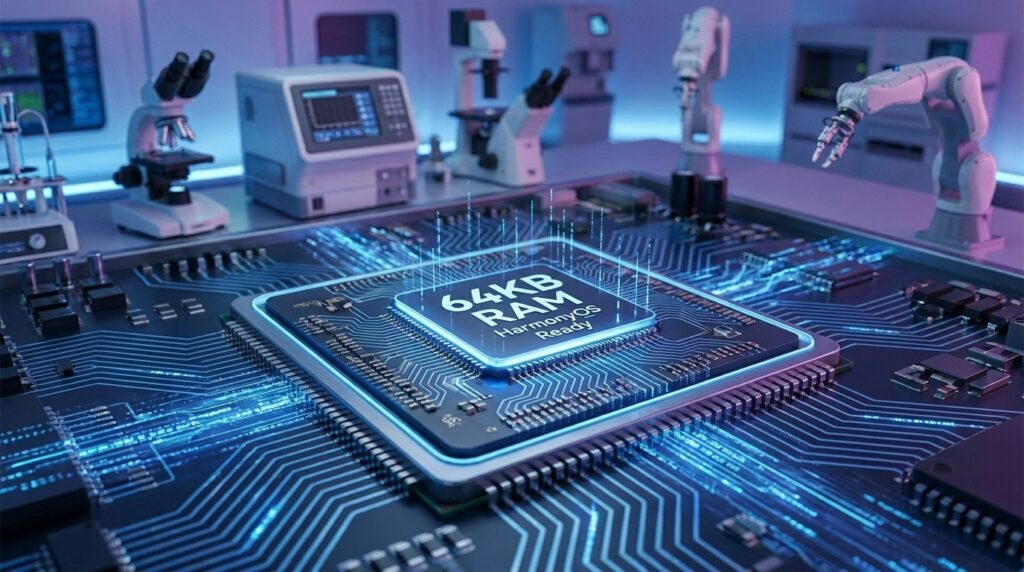
Regarding HarmonyOS’s future, Huawei has made a daring assertion. An executive from the company claims that the operating system can be optimised to run on just 64KB of RAM.
What’s even more amazing is that devices that use this optimised version might be able to run on a single dry cell battery for a full year.
An Increase in Efficiency
The RAM capacity of modern smartphones is usually between 8GB and 16GB. 64KB is incredibly little in contrast.
This illustrates Huawei’s emphasis on efficiency as opposed to just boosting hardware power.
Developed for Internet of Things Devices
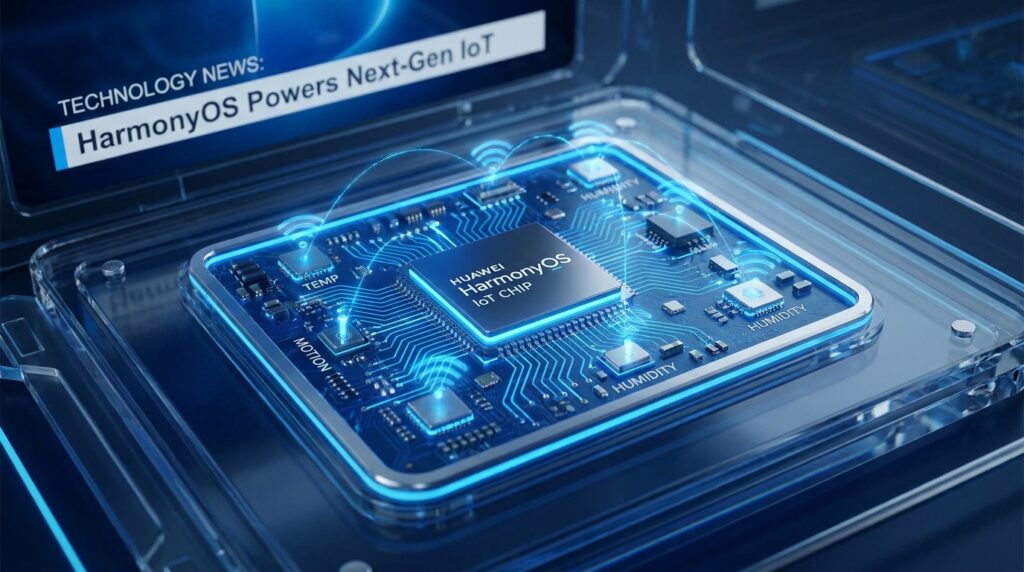
Smartphones are no longer the only devices that can run HarmonyOS. The platform is being expanded by Huawei into the Internet of Things (IoT) sector.
The operating system is intended to run wearables, industrial equipment, home automation items, and smart sensors.
The Significance of 64KB RAM
Generally speaking, low-memory gadgets are less expensive to produce. They also use less energy.
Manufacturers might create reasonably priced smart devices with less hardware if HarmonyOS can operate dependably with just 64KB of RAM.
Extended Battery Life
One of the key issues with linked devices is still battery life.
According to Huawei, HarmonyOS can be sufficiently optimised to enable some devices to function for up to a year on a single battery.
Advantages of Intelligent Sensors
A lot of IoT sensors are placed in places where changing the batteries is challenging.
Reliability can be increased and maintenance expenses can be decreased with a longer-lasting operating system.
Applications for Smart Homes
Reduced power usage could be advantageous for temperature monitors, motion detectors, and smart door sensors.
Batteries wouldn’t need to be changed as often.
Healthcare Prospects
Long battery life and small designs are essential for wearable health devices.
Manufacturers may be able to create more effective medical monitoring devices with the aid of an enhanced HarmonyOS platform.
Farming and Agriculture
Connected sensors are becoming more and more important in modern farms.
Low-power gadgets don’t require regular battery changes to monitor temperature, irrigation systems, and soil conditions.
Automation in Industry
Thousands of sensors are frequently used in factories to monitor machinery.
While maintaining system connectivity, a lightweight operating system can lower energy consumption.
Development of Smart Cities
Sensors are used by cities for public infrastructure, air quality monitoring, and traffic control.
These large-scale deployments may be more feasible and economical with long battery life.
The Ecosystem Vision of Huawei
Huawei wants HarmonyOS to create a unified ecosystem that links wearables, smartphones, household appliances, and industrial goods.
One crucial step in reaching that objective is supporting ultra-low-power hardware.
Difficulties Remain
It takes a lot of program optimisation to run on just 64KB of RAM.
The device, workload, connectivity, and general usage patterns will all affect real-world performance.
The IoT Market’s Competition
The IoT industry is already served by a number of operating systems.
Huawei expects that HarmonyOS’s ecosystem integration and scalability will make it stand out.
The Future Consequences of This
Huawei is making significant investments in low-power computing, as the news demonstrates.
Efficiency might become as crucial as computing power when billions of linked devices come online.
Concluding Remarks
The platform’s aspirational objectives are highlighted by Huawei’s assertion that HarmonyOS can run on 64KB RAM and last a year on a single battery.
HarmonyOS may emerge as a viable option for linked technologies, smart sensors, and next-generation IoT devices if these improvements are effective.
FAQ
Is 64KB RAM really enough to run HarmonyOS?
According to Huawei officials, HarmonyOS is appropriate for lightweight IoT hardware since it can be optimised for devices with as low as 64KB RAM.
Which gadgets might profit from this optimisation?
Smart meters, smart sensors, smart household appliances, industrial machinery, health monitors, and agricultural monitoring systems might all profit.
Why is a one-year battery life crucial?
Long battery life increases dependability, lowers maintenance costs, and permits deployment in remote areas.
Is HarmonyOS limited to smartphones?
No, Huawei is extending HarmonyOS to wearables, smartphones, IoT ecosystems, industrial devices, and smart home products.
What is the difference between HarmonyOS and other IoT operating systems?
HarmonyOS supports both consumer electronics and lightweight IoT devices because of its emphasis on ecosystem integration and scalability.