Battery life is frequently one of the most important considerations when purchasing a premium smartphone. If your phone can’t last a full day, its strong processor, sophisticated cameras, and gorgeous display don’t matter anything. Because of this, one of the most eagerly awaited comparisons among smartphone fans is the iPhone 17 vs. Google Pixel 10 battery test.
Google and Apple have approached battery optimisation in different ways. Google employs Android 17, AI-powered energy management, and Tensor G5 optimisation to provide longer battery life, while Apple places a strong emphasis on hardware and software integration through iOS.
Both smartphones seem to offer all-day performance on paper, but specs don’t often convey the whole picture. Display efficiency, CPU optimisation, camera usage, game performance, network connectivity, and software intelligence are some of the variables that affect battery performance in real life.
We’ll look at how both flagship handsets function in real-world scenarios in our in-depth comparison to help you determine which smartphone actually offers the better battery experience.
A Brief Synopsis
It is anticipated that the iPhone 17 will carry on Apple’s legacy of striking a balance between remarkable power efficiency and battery capacity. Apple usually achieves remarkable durability through optimised hardware, effective chipsets, and sophisticated background management rather than employing the largest battery.
With Google’s Tensor G5 CPU and AI-driven battery optimisation, the Google Pixel 10 is anticipated to offer additional enhancements. In order to prolong battery life, Google’s Adaptive Battery technology learns user habits and restricts pointless background activity.
Although both smartphones strive to offer dependable all-day use, their approaches are very different.
Google places more emphasis on artificial intelligence and adaptive resource management, whereas Apple prioritises efficiency through close hardware-software interaction.
Because of this distinction, real-world battery testing is significantly more crucial than merely comparing battery capacities.
Overview of the iPhone 17 Battery
Even while battery capacity hasn’t changed significantly over time, Apple has continuously improved battery efficiency.
The anticipated features of the iPhone 17 are:
An energy-efficient manufacturing technique underpins the advanced A19 chipset.
Better OLED screen with adjustable refresh rate
More intelligent control of background apps
Improved optimisation of battery health
Improved thermal control for long-term performance
Battery efficiency is also greatly enhanced by Apple’s ecosystem. Every component is optimised to use the least amount of power throughout daily work since Apple designs both the hardware and the software.
Because iOS strictly regulates background processes, activities like messaging, browsing, photography, FaceTime, and video playing typically demand less energy than many Android competitors.
With larger batteries, iPhones frequently outperform Android phones because to this integrated ecosystem.
Overview of the Google Pixel 10 Battery
Over the past few years, Google has placed a lot of emphasis on AI-powered battery optimisation, and the Pixel 10 is anticipated to carry on this trend.
Improvements to batteries are anticipated to include:
Tensor G5 CPU
Improved Adaptive Battery Technology
More intelligent use of AI resources
Enhanced optimisation of background apps
An OLED display with more efficiency
Improved thermal regulation
Google teaches the phone to comprehend user behaviour instead than just expanding the battery.
For instance:
Apps that are utilised frequently are given greater resources.
Apps that are rarely used require very little background power.
Charging patterns are immediately picked up.
The goal of overnight charging is to minimise battery deterioration.
During regular use, these AI advancements can greatly increase battery life.
Comparison of Battery Capacity
Battery capacity is a significant factor, but it should never be the sole measure of battery performance.
Longer battery life is not always assured by a larger battery.
Overall endurance is influenced by a number of additional elements, such as:
Processor effectiveness
Technology for displays
Brightness of the screen
Rate of refresh
Optimisation of software
Background administration of apps
AI battery education
Efficiency of heat
Efficient hardware can outperform devices with far larger batteries, as Apple has shown time and time again.
In contrast, Google maximises longevity by combining a bigger battery with clever software optimisation.
This makes the real-world battery test much more significant than just comparing battery specifications.
Methods of Testing
Both smartphones should be tested under the same circumstances in order to get a fair battery comparison.
Throughout testing, the following configurations are maintained:
Set the brightness of the display to about 50%.
Wi-Fi is turned on
Location services are active and Bluetooth is turned on.
The refresh rate is automatically set.
The same programs are installed
Comparable notification configurations
Equivalent network circumstances
Batteries that are fully charged prior to testing
Because real-world battery tests represent how most users actually use their cellphones on a daily basis, they are far more valuable than laboratory measurements.
Battery Test for Daily Use
The majority of users don’t play video games or record videos all day.
Rather, a normal day consists of things like:
Examining emails
Looking through websites
Observing YouTube
Scrolling through Instagram
Using TikTok
Responding on WhatsApp
Making video calls
Playing Spotify
Taking pictures
Using Maps on Google
Both cellphones should be able to last a whole day with light-to-moderate use.
They use batteries differently, though.
Because of iOS’s effective memory and background management, the iPhone 17 is anticipated to exhibit impressively steady battery depletion throughout the day.
In contrast, the Pixel 10 may use a little more power when multitasking, but it makes up for it with Adaptive Battery, which learns your daily schedule and gradually cuts down on needless background activities.
Performance of the Screen-On Time
Because it gauges how long the display is active while you are actively using the phone, screen-on time (SOT) is still one of the most significant indicators of battery performance.
Screen-on time is influenced by the following factors:
Show brightness
Rate of refresh
Strength of the network signal
Optimisation of apps
Processor effectiveness
Playback of videos
The intensity of gaming
Because of Apple’s effective A19 chip and optimised OLED display, the iPhone 17 is anticipated to have a very constant screen-on time.
With its Tensor G5 CPU, the Google Pixel 10 is also anticipated to perform well, especially once its Adaptive Battery system has figured out how you use it.
Both smartphones will likely provide all-day battery life for users who primarily use them for social media browsing, video streaming, and daily work.
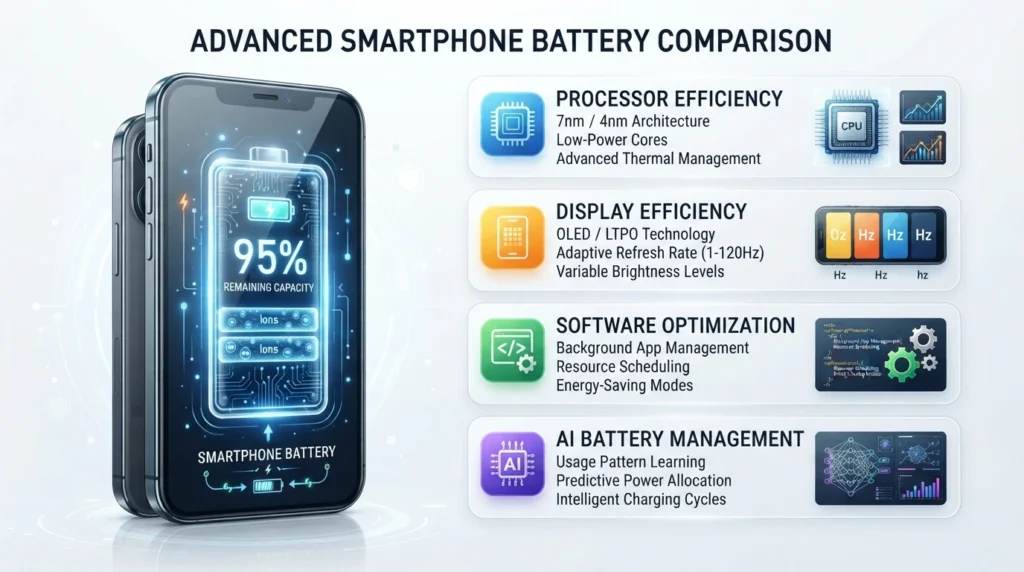
Why Battery Optimisation Is More Important Than Battery Capacity
Many consumers believe that a larger battery will last longer.
In actuality, battery optimisation frequently has a bigger effect than battery capacity on its own.
For instance:
A processor that is efficient uses less electricity and produces less heat.
Background activity is decreased by intelligent software.
Adaptive refresh rate technology helps minimize display power usage by automatically adjusting the screen’s refresh frequency based on the content being viewed.
AI-driven resource management stops needless battery waste.
Because of this, flagship smartphones frequently perform better than mid-range models even when their battery capacities are comparable or even lower.
Although they use distinct technology, Apple and Google both excel at battery optimisation.
Battery Performance in the Real World
Only a portion of the narrative is revealed by battery parameters. When a smartphone is used constantly throughout the day for communication, business, entertainment, navigation, and photography, the true problem starts.
Both the Google Pixel 10 and the iPhone 17 are tested under typical usage conditions to assess real-life endurance. Social media browsing, video streaming, photography, gaming, messaging, site surfing, and navigation are some of these activities.
A flagship phone should be able to run continuously from dawn till dusk without needing to be recharged. This is when battery capacity and software optimisation become equally crucial.
Battery Test for Social Media
The majority of smartphone users utilise social media sites for many hours each day.
Well-known applications like:
Reddit, Instagram, Facebook, TikTok, X (Twitter), and Snapchat
are among the largest users of batteries due to their continuous content refresh, autoplay movies, and real-time internet connectivity.
Performance of the iPhone 17
It is anticipated that the iPhone 17 would function remarkably well when using social media because of:
Effective control of background processes
iOS app performance optimisation
Adaptive refresh rate that is smooth
Increased RAM use
Battery drain is likely to be steady without abrupt percentage dips, even after prolonged scrolling sessions.
Performance of the Google Pixel 10
The Google Pixel 10 is mostly dependent on Tensor G5 AI optimisation and Android’s Adaptive Battery.
Battery consumption may seem a little greater at first, however the phone intelligently lowers power consumption for less frequently used apps after learning the user’s behaviour over a few days.
Long-term battery performance becomes more effective as a result.
Test of YouTube Video Playback
One of the simplest methods to assess CPU optimisation and display efficiency is to stream videos.
Regarding this test:
The brightness of the display stays at 50%.
Wi-Fi remains active.
The auto brightness feature is turned off.
Continuous Full HD or 4K video streaming on the iPhone 17
Apple has continuously produced top-notch video playback capabilities due to:
Effective OLED technology
Hardware decoding of videos
Optimising low-power displays
Outstanding power control
With minimal power consumption, users may anticipate playing videos continuously for several hours.
Pixel 10 from Google
Compared with previous generations, Google has significantly improved the power efficiency of its OLED display technology.
The Pixel 10 is anticipated to provide extremely competitive video playback times when paired with Tensor G5 optimisation.
YouTube and Netflix are examples of streaming services that should run smoothly and use a fair amount of battery life.
Test of Gaming Batteries
One of the hardest things a smartphone can do is play games.
Well-liked games consist of:
Asphalt Legends, PUBG Mobile, Call of Duty Mobile, Genshin Impact, and EA FC Mobile
These books make extensive use of:
CPU, GPU, Display, and RAM
link to the internet
making them perfect for assessing battery performance.
Gaming Performance of the iPhone 17
It is anticipated that Apple’s A19 CPU would provide exceptional gaming efficiency.
Benefits consist of:
Consistent frame rates
Reduced production of heat
GPU power consumption that is efficient
Improved battery performance under high load
Battery consumption should be predictable even after prolonged game sessions.
Gaming Performance of the Google Pixel 10
Tensor G5 continues to enhance gaming performance while concentrating on AI computing.
Among the anticipated strengths are:
Improved thermal optimisation
Enhanced graphics effectiveness
Adaptive scaling of performance
Allocating resources wisely
It is anticipated that the difference will be minimal, even though power consumption while gaming may be marginally higher than that of the iPhone 17.
Test of the Camera Battery
Advanced image processing, HDR techniques, AI improvements, and video stabilisation are key components of contemporary smartphone cameras.
Significant computing power is needed for these functionalities.
Testing consists of:
Night Mode for Portrait Photography
HDR pictures
Constant photography and 4K video capture
recording in slow motion
Use of the iPhone 17 Camera
Apple has a very effective image processing pipeline.
It is anticipated that users who record several movies during the day would encounter:
Consistent battery use
Very little overheating
Reliable camera performance
The A19 chip uses less energy while processing photos quickly.
Use of the Google Pixel 10 Camera
AI plays a major role in Google’s computational photography.
characteristics like:
AI Photo Enhancement with Magic Editor’s Best Take
Sight at Night
need more processing power.
Long-term photography sessions may use a little more battery than regular camera use, even if Tensor G5 is optimised for AI operations.
Battery Test for Navigation
Apps for navigation constantly access:
GPS Mobile Data Display Processor Rendering Maps
Some of the most battery-intensive activities are these ones.
Testing entails the use of:
Apple Maps and Google Maps
Real-time traffic reports
Navigating by voice
for a long trip.
Anticipated Outcomes
Thanks to Apple’s optimised location services, the iPhone 17 should continue to operate with exceptional efficiency.
Although constant AI-assisted route processing may marginally boost battery drain throughout longer excursions, the Google Pixel 10 is also anticipated to perform well.
Test of a Standby Battery
The amount of battery that a smartphone loses when not in use is determined by its standby performance.
Very little charge should be lost overnight on a high-end flagship.
The iPhone 17
When the phone is not in use, Apple’s rigorous background management reduces battery depletion.
Because background programs are strictly regulated, the device can effectively conserve battery.
Pixel 10 from Google
Google’s Adaptive Battery strategy limits the amount of resources that unused apps can utilise.
Standby battery performance improves dramatically from the initial setup phase after the system learns user behaviour.
Comparison of Charging Speeds
As cellphones are used more frequently throughout the day, fast charging has become more crucial.
Important elements consist of:
Time needed to get to 50%
Time needed to get to 80%
Duration of full charging
Heat produced while charging
Preservation of battery health
The iPhone 17
In general, Apple places a higher priority on battery longevity than incredibly quick charging.
Benefits anticipated include:
regulated rates of charging
Improved battery health over time
Reduced temperatures during charging
Optimised Battery Charging using Intelligence
Pixel 10 from Google
With each iteration, Google keeps advancing charging technologies.
It is anticipated that the Pixel 10 will support:
Quicker connected charging
Better wireless charging
AI-assisted optimisation of charging
Improved protection for overnight charging
While Apple concentrates on extending battery life, Google’s charging technique may appeal to those who seek quicker top-ups.
Thermal and Heat Management
Both battery performance and long-term battery health are directly impacted by heat.
Overheating can:
Diminish battery performance
Reduced performance in games
induce thermal throttling
Accelerate the iPhone 17’s battery ageing
Under prolonged workloads, Apple’s processing efficiency contributes to reduced temperatures.
It is anticipated that the phone will stay comfortable throughout:
Playing video games
Streaming chores related to productivity
Pixel 10 from Google
Compared to earlier Tensor processors, the Tensor G5 offers improved thermal control.
Improved cooling and software optimisation could lessen warming during prolonged use, even when AI processing adds to workloads.
Features of Battery Optimisation
Although both smartphones have clever battery-saving features, they take distinct approaches to optimisation.
Apple’s Optimisation of Batteries
Enhanced Charging of Batteries
Control for Background App Refresh
Mode of Low Power
Effective memory management on iOS
Schedule of intelligent charging
Google’s Optimisation for Batteries
Flexible Battery
Superior Battery Preserving
Prediction of AI apps
Flexible Charging
Intelligent background limitations
While Google uses machine learning to adjust to each user’s preferences, Apple prioritises efficiency through hardware and software integration.
Battery Comparison Table
| Feature | iPhone 17 | Google Pixel 10 |
|---|---|---|
| Battery Optimization | Excellent | Excellent |
| Processor Efficiency | Outstanding | Very Good |
| Daily Battery Backup | Excellent | Excellent |
| Gaming Efficiency | Excellent | Very Good |
| Video Playback | Excellent | Very Good |
| Camera Battery Usage | Excellent | Very Good |
| Heat Management | Excellent | Good |
| Charging Speed | Good | Very Good |
| Standby Battery | Excellent | Excellent |
| AI Battery Features | Good | Outstanding |
Note: Battery performance can vary depending on display brightness, network conditions, installed apps, software updates, and individual usage habits.
Overall Battery Score
To simplify the comparison, here’s an overall battery rating based on typical flagship smartphone performance factors.
| Category | iPhone 17 | Google Pixel 10 |
|---|---|---|
| Daily Usage | ⭐⭐⭐⭐⭐ | ⭐⭐⭐⭐⭐ |
| Gaming | ⭐⭐⭐⭐⭐ | ⭐⭐⭐⭐☆ |
| Streaming | ⭐⭐⭐⭐⭐ | ⭐⭐⭐⭐☆ |
| Camera Usage | ⭐⭐⭐⭐⭐ | ⭐⭐⭐⭐☆ |
| Charging | ⭐⭐⭐⭐☆ | ⭐⭐⭐⭐⭐ |
| Standby | ⭐⭐⭐⭐⭐ | ⭐⭐⭐⭐⭐ |
| Battery Optimization | ⭐⭐⭐⭐⭐ | ⭐⭐⭐⭐⭐ |
Benefits and Drawbacks
Pros of the iPhone 17
Outstanding iOS battery optimisation.
Consistent performance thanks to the very efficient A19 chip.
seamless battery use when multitasking and playing games.
exceptional standby battery life.
reduce the amount of heat produced when working hard.
Longer battery life is aided by optimised battery charging.
Outstanding performance when using the camera and playing videos.
Cons of the iPhone 17
Some Android competitors may still have worse charging speeds.
restricted customisation of charging.
On paper, battery capacity could seem lower than that of competitors.
Depending on the market, the packaging might or might not include a fast charger.
Pros of the Google Pixel 10
robust Adaptive Battery system based on AI.
quicker wired charging than a lot other flagship products.
Outstanding software optimisation once user habits are understood.
robust battery performance when performing daily duties.
clever control of background apps.
Android has practical battery-saving measures.
Excellent efficiency and performance balance.
Cons of the Google Pixel 10
The battery life for gaming could not be as good as Apple’s optimisation.
When used intensively, AI features may result in higher battery consumption.
Before Adaptive Battery fully learns usage patterns, battery performance may vary significantly over the first few days.
Compared to iOS, heavy multitasking can use more power.
Which Phone Has a Longer Battery Life?
Your priorities will determine whether you choose the Google Pixel 10 or the iPhone 17.
Select the iPhone 17 if you
Desire reliable battery performance throughout the day.
Play games with a lot of graphics.
Make material or record lengthy videos.
Excellent standby battery life is preferred.
Appreciate optimal performance and long-term battery health.
are already included in the ecosystem of Apple.
Select the Google Pixel 10 if you
Prefer Google’s software and Android.
Desire battery optimisation driven by AI.
Faster charging is required for rapid top-ups.
Make liberal use of Google services.
Enjoy clever battery management that adjusts to your everyday routine.
Final Decision
Although both the Google Pixel 10 and the iPhone 17 are anticipated to have remarkable battery lives, their strengths differ.
With its remarkable power economy, steady battery drain, reduced heat production, and amazing performance in gaming, video playback, and everyday multitasking, the iPhone 17 stands out. Apple is able to maximise battery life without exclusively depending on a larger battery thanks to its close integration of hardware and software.
On the other hand, the Google Pixel 10 excels because to its AI-driven battery management, quicker charging, and adaptive software that gradually picks up on user behaviour. For consumers who mostly rely on Android features and Google’s ecosystem, its clever optimisation makes it an appealing choice.
The iPhone 17 is probably going to have a small advantage for users looking for consistent, long-lasting battery performance in demanding situations. However, the Google Pixel 10 might be a superior option for people who value AI-powered efficiency and quicker charging.
FAQ
- Is the Google Pixel 10 or the iPhone 17 more battery-efficient?
All-day battery life is anticipated for both. While the Pixel 10 concentrates on AI-powered optimisation, the iPhone 17 might have a little edge in long-term performance and efficiency.
- Which phone charges most quickly?
It is anticipated that the Google Pixel 10 will enable quicker cable charging than the iPhone 17.
- Is battery size the key factor in determining overall smartphone performance?
No, real-world battery life is frequently more influenced by processor efficiency, display technology, software optimisation, and background app management.
- What phone is ideal for gaming?
It is anticipated that the iPhone 17 would offer more reliable gaming performance together with less heat production and effective power usage.
- Does Adaptive Battery Actually Help?
Indeed. Over time, Google’s Adaptive Battery increases battery life by learning your usage patterns and limiting power consumption for less utilised apps.
- Which phone’s standby battery lasts longer?
It is anticipated that both devices will function very well, with little battery depletion during idle times.
- How does a refresh rate of 120Hz impact battery life?
Indeed. Adaptive refresh rate technology helps lower energy use when high refresh isn’t required, while higher refresh rates use more power.
- Which phone works best for streaming videos?
Because of Apple’s effective hardware and software integration, the iPhone 17 is anticipated to provide slightly longer video playback.
- Does gaming harm batteries?
Regular high-performance gaming raises the temperature, which over time might hasten battery deterioration. Battery health can be maintained by following proper charging procedures and avoiding extreme heat.
- What phone is ideal for travellers?
Both are great options. While the iPhone 17’s effective battery usage can lessen the need for regular charging, the Pixel 10’s quicker charging is helpful when time is of the essence.
- Does battery life get longer with AI optimisation?
Indeed. While Apple employs intelligent system optimisation to accomplish similar objectives, Google’s AI features assist in controlling background activities and charging habits.
- Does quick charging damage batteries?
Protections to reduce battery deterioration are included into contemporary cellphones. Battery health can be preserved by using approved chargers and avoiding overheating.
- When used extensively, which phone maintains its coolness?
During prolonged gaming and video recording sessions, the iPhone 17 is anticipated to retain lower temperatures.
- What phone is ideal for content producers?
Because of its reliable battery performance and thermal management, the iPhone 17 might be a better option for consumers who film movies on a regular basis.
- If you want the best battery experience, which flagship should you purchase?
If your priority is long-lasting durability and dependable performance, the iPhone 17 is an excellent choice. On the other hand, the Google Pixel 10 stands out for users who prefer intelligent AI-based battery optimization along with faster charging capabilities.
In conclusion
Battery size is no longer the only factor that affects battery performance. To provide all-day endurance, modern flagship smartphones rely on sophisticated CPUs, clever software, adaptable screens, and AI-driven optimisation.
Two distinct philosophies are represented by the Google Pixel 10 and the iPhone 17. While Google employs artificial intelligence to adjust battery usage depending on real-world patterns, Apple concentrates on the smooth integration of hardware and software to achieve constant, efficient battery performance.
In the end, most users should be satisfied with both smartphones after a typical full day of use. Rather than relying solely on battery capacity, your choice should take into account your preferred ecosystem, charging preferences, and usage habits.