China has successfully produced high-purity Silicon-28, a material thought to be crucial for the upcoming generation of quantum computers, marking a major milestone in the realm of quantum technology. This advancement is a significant step in creating quantum systems that are more potent, reliable, and scalable. China’s advancements in Silicon-28 manufacture show its dedication to developing cutting-edge technology as nations vie to spearhead the quantum computing revolution.
Many people believe that one of the most revolutionary technologies of the twenty-first century is quantum computing. Quantum computers use qubits, which may carry out several computations at once, in contrast to conventional computers that process information using bits. However, one of the key obstacles in quantum research is still creating dependable qubits. By lowering quantum noise and boosting qubit stability, high-purity Silicon-28 presents a viable remedy.
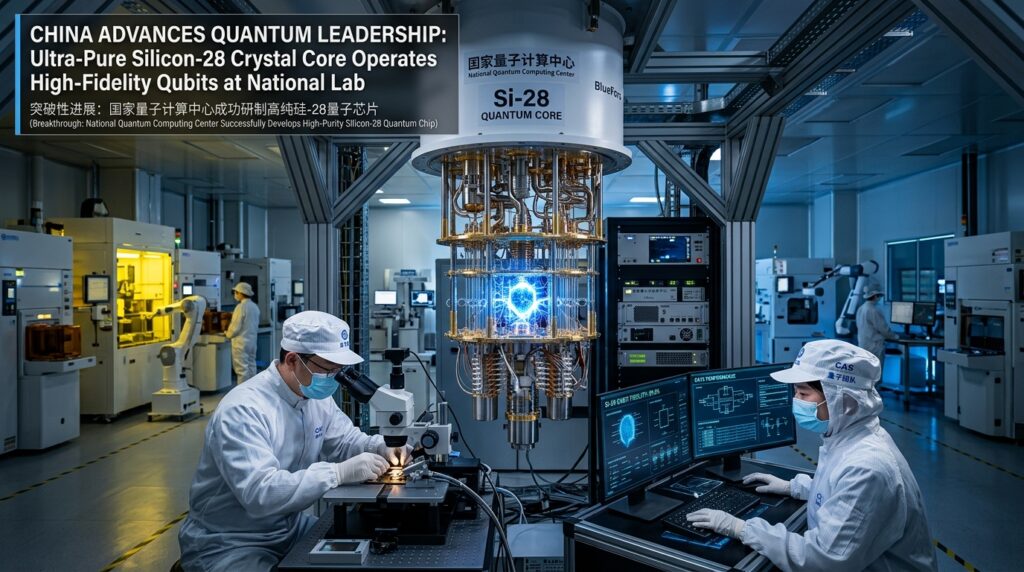
Silicon-28: What Is It?
One naturally occurring isotope of silicon is silicon-28. Although a variety of isotopes, including silicon-28, silicon-29, and silicon-30, are present in ordinary silicon, silicon-28 is distinct due to its lack of nuclear spin. It is quite appealing for applications involving quantum computing because of this feature.
Decoherence is the term for the phenomena wherein qubits in quantum processors lose information due to even minute perturbations. Scientists can greatly lessen these disruptions and produce qubits that stay stable for longer by utilising highly purified Silicon-28.
“Producing ultra-pure Silicon-28 represents an important technological breakthrough due to the complex methods, advanced infrastructure, and extensive expertise required.”
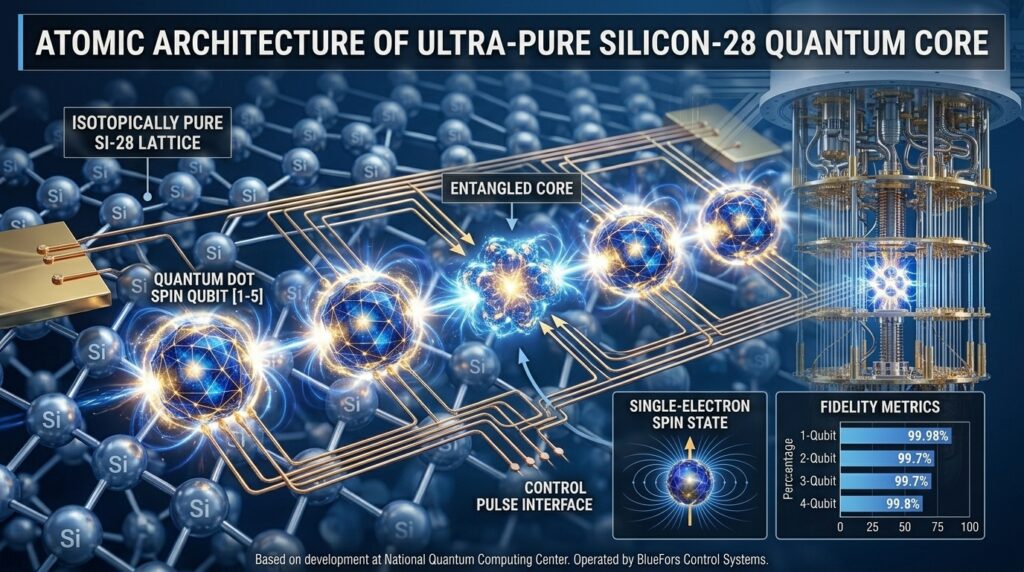
The Significance of High-Purity Silicon-28
Any quantum computer’s performance is largely dependent on the calibre of its qubits. Unwanted noise is frequently introduced by conventional semiconductor materials, interfering with quantum operations.
High-purity Silicon-28 offers a number of benefits:
Extended coherence durations of qubits
Diminished quantum errors
Increased accuracy in calculations
Simpler integration using current semiconductor technology
Future quantum processors will be more scalable.
Silicon-28 is one of the most sought-after materials in quantum computing research because of these advantages.
China’s Innovation in the Production of Silicon-28
China’s most recent accomplishment shows its expanding proficiency in quantum research and advanced chip fabrication. According to reports, scientists have created techniques to enhance Silicon-28 to incredibly high purity levels appropriate for quantum applications.
It must be separated from other silicon isotopes in order to produce high-purity silicon-28. Since 92% of naturally occurring silicon is Silicon-28, advanced enrichment methods are required to achieve the ultra-high purity levels required for quantum computing.
China is now one of the few nations able to produce quantum-grade Silicon-28 thanks to this development.
This achievement further enhances China’s local quantum technology ecosystem and lessens reliance on foreign vendors.
How Quantum Computing Is Enhanced by Silicon-28
- Improved Stability of Qubits
Sustaining qubit stability is a major challenge in quantum computing. The spin-free atomic structure of silicon-28 reduces magnetic interference, enabling qubits to store data for extended periods of time.
- Lower Error Rates
Even the smallest environmental disturbances can affect the performance of quantum systems.” High-purity Silicon-28 lowers the possibility of computer errors by reducing background noise.
- Increased Scalability
Millions of qubits will be needed for future quantum computers. Architectures based on silicon-28 provide a mechanism to scale quantum processors without sacrificing performance.
- Compatibility with Current Chip Production
Silicon-28 may be incorporated into current semiconductor manufacturing techniques, in contrast to certain exotic quantum materials. Commercial adoption may be accelerated by this compatibility.
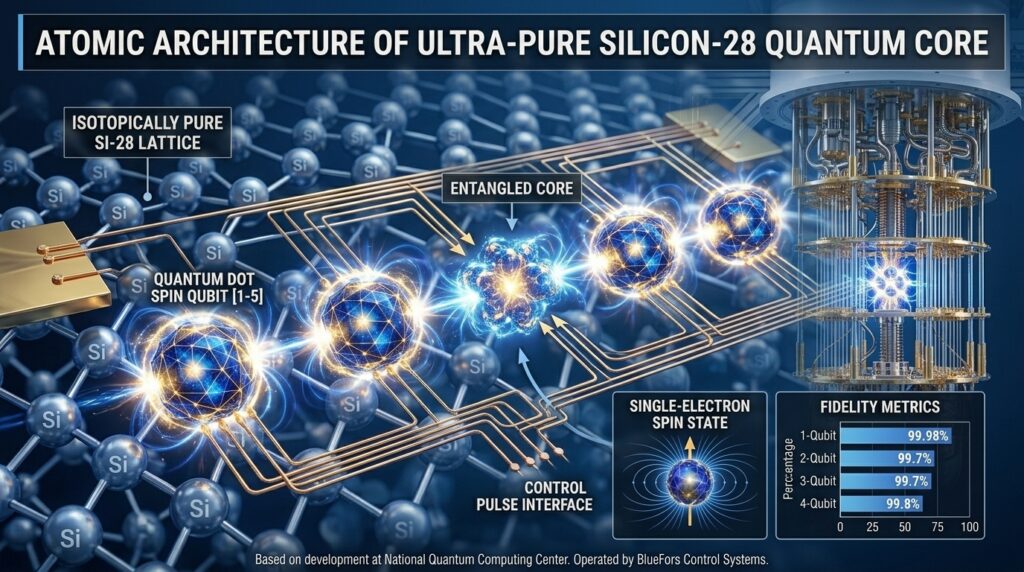
China’s Increasing Quantum Technology Leadership
Over the past ten years, China has made significant investments in quantum research. The nation has already accomplished a number of noteworthy firsts, such as:
Networks for quantum communication
Systems for quantum encryption
Quantum experiments conducted from satellites
Research on advanced quantum computing
Another significant accomplishment for China’s growing quantum portfolio is the successful fabrication of high-purity Silicon-28.
Innovation in this area has accelerated because to government assistance, academic research initiatives, and partnerships with tech firms.
Worldwide Race for Quantum Computing
Silicon-28 technology is being developed in the face of fierce global competition.
Billions of dollars are being spent on quantum research by a number of countries, including:
United States, China, Germany, Japan, Canada, and the United Kingdom
Prominent tech firms are also making significant investments in the development of quantum gear. Having access to superior materials like Silicon-28 is becoming more and more seen as a tactical advantage.
China’s discovery may improve its standing in this worldwide competition and facilitate further developments in quantum hardware.
Possible Uses for Silicon-28 Quantum Computers in Drug Development
Researchers could find new medications more quickly by using quantum computers to model molecular interactions with previously unheard-of fidelity.
Artificial Intelligence
Cutting-edge quantum processors could improve AI decision-making and machine learning techniques.
Modelling Finances
Quantum systems could be used by financial firms to optimise investment plans and analyse intricate market scenarios.
Research on Climate
Scientists may be able to better comprehend environmental systems, climate change, and weather patterns with the aid of quantum simulations.
Cybersecurity
By revolutionising cryptography, quantum technology could strengthen communication systems’ defences against upcoming cyberattacks.
Difficulties Ahead
Despite the success, there are still a number of obstacles to overcome before Silicon-28-based quantum computers are widely used.
Complexity of Manufacturing
Highly specialised tools and knowledge are needed to produce ultra-pure Silicon-28.
Expensive
Large-scale implementation is still restricted by the high cost of the enrichment process.
Correction of Quantum Errors
Quantum systems still need sophisticated error-correction techniques, even with Silicon-28.
Timeline for Commercialisation
Practical large-scale quantum computers are still years away from being widely used, according to experts.
Benefits and Drawbacks of High-Purity Silicon-28
Extended coherence durations of qubitscostly method of manufacture
Diminished quantum noiseComplex separation of isotopes
Increased precision in calculationrestricted worldwide supply
Compliant with the production of semiconductorsneed cutting-edge facilities
“It enables the development of larger and more efficient quantum processing systems, although widespread commercial adoption is still at an early stage.”
bolsters the country’s technological independenceThe expense of research is still high.
Effects on the Semiconductor Sector
The wider semiconductor industry may be impacted by China’s achievement in manufacturing quantum-grade Silicon-28. Specialised materials are becoming more and more crucial as demand for cutting-edge computing systems rises.
The discovery could spur further funding for:
Production of semiconductors
Development of quantum hardware
Research in materials science
Advanced manufacturing of chips
Additionally, it might assist businesses engaged in quantum supply chains find new opportunities.
Outlook for the Future
China’s aspirations for quantum technology have advanced significantly with the successful manufacturing of high-purity Silicon-28. Silicon-28 is anticipated to be crucial to the development of dependable and scalable quantum processors as scientists continue to advance quantum electronics.
Even though there are still many technical obstacles to overcome, this accomplishment shows how quickly quantum research is developing. In the upcoming decades, nations that are proficient in both quantum hardware and software will probably benefit economically and technologically.
China’s advancements show that the global quantum race is picking up speed, and innovations in specialised materials like Silicon-28 could influence computing in the future.
Silicon-28: What is it?
Because silicon-28 lacks nuclear spin, it is an excellent choice for reliable quantum computing applications.
Why is Silicon-28 crucial to quantum computing?
“By suppressing disruptive quantum effects, it strengthens qubit performance and allows sensitive quantum information to be retained for extended periods.”
With Silicon-28, what did China accomplish?
High-purity Silicon-28 appropriate for advanced quantum computing research and development was successfully created in China.
How does Silicon-28 enhance the performance of qubits?
Longer coherence periods and fewer computational mistakes result from its spin-free structure, which reduces magnetic interference.
Is Silicon-28 compatible with conventional computers?
Although some sophisticated semiconductor applications might also profit from it, quantum computing is its main use.