Offering steep discounts on electronics, apparel, household appliances, and cellphones, the yearly 618 shopping festival has long been regarded as one of China’s largest online retail events. Manufacturers of smartphones used the occasion to increase sales and get rid of inventory for many years.
The findings for this year, however, present a different picture.
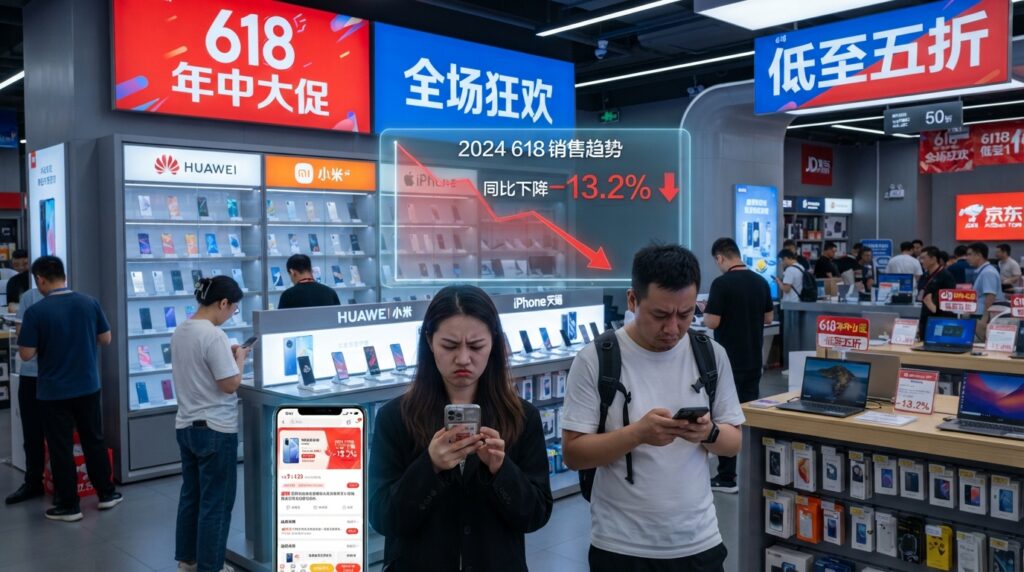
China’s smartphone sales dropped 13% during the 618 shopping festival, according to recent market figures, which alarmed smartphone manufacturers, retailers, and industry analysts. Longer smartphone replacement cycles, changed customer preferences, economic instability, and fierce brand competition are all contributing factors to the fall.
This essay examines the main causes of the drop, how it has affected the smartphone market, and what manufacturers and users should anticipate in the upcoming months.
Comprehending the 618 Shopping Festival
The 618 shopping festival started off as a marketing initiative honouring the anniversary of one of the biggest online retailers in China. It developed become one of the largest internet shopping occasions in the nation over time, surpassed only by Singles’ Day.
Millions of customers wait for the festival each year to buy electronics at a discount. To draw customers, smartphone manufacturers frequently offer special discounts, cashback incentives, trade-in schemes, and packaged accessories.
Due to its size, the event is seen as a key gauge of Chinese consumer spending and smartphone demand.
Sales of smartphones in China fell by 13%.
This year’s festival saw a sharp drop in smartphone sales despite intense advertisements and alluring discounts.
Instead of identifying a single cause, industry analysts identify multiple contributing elements. While customers continued to shop online, their spending switched away from high-end cellphones and toward everyday necessities, tourism, household goods, and health-related expenditures.
The 13% decline shows that discount offers alone are no longer enough to encourage consumers to replace their existing smartphones.
Why Sales of Smartphones Dropped
Consumers Are Using Their Smartphones for Longer Periods ⭐
The longer lifespan of contemporary devices is one of the main causes of the decline in smartphone sales.
The smartphones of today provide:
Quicker processors
Extended battery life
Superior cameras
Extended software support
Increased robustness
Because of this, many consumers don’t see the need to replace a phone that continues to function properly after three or four years.
Uncertainty in the Economy
Ongoing economic challenges have made consumers more cautious about their spending decisions. ✅
Rather than buying pricey electronics, more households are putting savings and necessary spending first.
Customers may put off upgrading their smartphones until absolutely required, even with promotional reductions.
Less Innovative Innovations
Earlier smartphone generations introduced major improvements in camera systems, display technology, and overall performance, making upgrades more appealing.
Annual improvements are now more gradual.
The urgency to upgrade is diminished because many buyers feel that the newest models only slightly improve upon earlier models.
The market for smartphones is saturated.
China already has one of the highest rates of smartphone adoption in the world.
Manufacturers struggle to draw in new customers because the majority of consumers already own capable smartphones.
Convincing current users to swap out working gadgets is now a major factor in growth.
Enhanced Rivalry
Brands of smartphones continue to compete fiercely.
Manufacturers maintain their competitiveness by:
Reduced costs
AI-powered features are available through trade-in.
Smartphones that fold
High-end camera systems
Although consumers gain from competition, it also narrows profit margins and complicates sales growth.
Which Brands of Smartphones Are Most Affected?
While overall sales decreased, the impact on various brands varied.
Because of their well-established ecosystems and software support, premium brands typically maintained higher levels of consumer loyalty.
As shoppers became more budget-conscious, mid-range smartphone brands faced mounting pressure to offer better value through competitive pricing.
Despite a decline in overall demand, brands that offered better value, longer software updates, and dependable after-sales support remained somewhat competitive.
Shifting Consumer Purchase Patterns
Today’s smartphone consumers are growing more pragmatic.
Instead of replacing their smartphones every year or two, many consumers now ask themselves:
Does my present phone still function properly?
Do the new features justify the cost?
Can I hold off for another year?
This change is indicative of a more developed smartphone market where buying decisions are driven more by necessity than by enthusiasm.
Artificial Intelligence’s Expanding Role
One of the main selling factors for modern smartphones is artificial intelligence.
AI-powered features like these are being introduced by manufacturers:
Astute photo editing
Voice assistants for real-time translation
Writing support
Optimisation of batteries
Tailored suggestions
Even if AI piques consumers’ interest, many still feel that these features are insufficient justifications for an instant upgrade.
AI advancements in the future might potentially boost demand for replacements.
The Growth of Foldable Smartphones
Foldable smartphones are still gaining popularity even though the overall smartphone industry has stalled.
Foldable devices are becoming more and more popular among consumers that value productivity, multitasking, and creative designs.
However, widespread acceptance is constrained by their higher pricing.
Over the coming years, foldable cellphones might become increasingly popular as manufacturing costs drop.
Effect on Manufacturers of Smartphones
For smartphone manufacturers, the drop in sales poses a number of difficulties.
Manufacturers could react by:
Cutting inventory
Modifying production timetables
Investing more in research
Providing more effective advertising campaigns
Enhancing programs for trade-ins
Entering foreign markets
Additionally, rather than depending only on hardware advancements, businesses will concentrate on creating distinctive software experiences.
What Retailers Should Know About This
It could be necessary for retailers taking part in the 618 festival to reconsider their sales tactics.
Promotions in the future can consist of:
Extensions of warranties
Free accessories
Options for financing
Services that require a subscription
AI software programs
Improved customer service
Offering more than just discounts could become more crucial.
Possibilities for Customers
Consumers may gain from decreased sales, even though producers may see it as a challenge.
Reduced demand frequently results in:
Greater savings
More affordable prices
Greater bonuses for trade-ins
Free accessories
Offers for extended warranties
Later in the year, patients may find even better smartphone deals.
Prospects for the Smartphone Market in China
China’s smartphone market is still among the biggest in the world, despite the brief slowdown.
Future growth could be supported by a number of factors:
Innovation in AI
Adoption of foldable smartphones
Better financial circumstances
Mobile technology of the future
Improved mobile photography
Extended battery life
Manufacturers are more likely to prosper if they can produce significant innovation rather than small improvements.
Expert Evaluation
A crumbling smartphone business is not necessarily indicated by the 13% fall during the 618 shopping festival.
Rather, it represents the organic development of an established market.
Before purchasing new gadgets, consumers are more pickier and demand real advancements.
In the upcoming years, brands that prioritise innovation, software quality, ecosystem integration, and customer pleasure are probably going to stay competitive.
Concluding Remarks
The 13% decline in smartphone sales in China during the 618 shopping holiday is more indicative of shifting consumer preferences than a decline in demand.
Smartphone replacement cycles have slowed due to a number of factors, including longer device lifespans, cautious spending patterns, a lack of breakthrough innovation, and market saturation.
Manufacturers face short-term difficulties as a result of the reduction, but it also motivates businesses to develop more successfully and produce goods with significant advancements.
In the future, consumers may benefit from improved pricing, more robust promotions, and more sophisticated smartphones as a result of the market’s evolution.
In the end, the smartphone market is moving into a new stage where long-term value, artificial intelligence, software experience, and quality will be considerably more important than just seasonal sales.
FAQ
What caused a 13% decline in smartphone sales in China during the 618 shopping festival?
Longer smartphone replacement cycles, frugal consumer spending, little hardware innovation, and a very crowded smartphone industry were the primary causes of the fall.
The 618 shopping festival: what is it?
One of China’s biggest yearly online shopping events is the 618 shopping festival, where merchants offer steep discounts on a variety of goods, including gadgets and smartphones.
Do customers purchase less smartphones?
Smartphones are not necessarily being abandoned by consumers. Rather, a lot of people are opting to hold onto their existing devices for a longer period of time before upgrading.
Will the cost of smartphones drop?
Manufacturers and merchants may be encouraged to implement more competitive pricing, trade-in programs, financing alternatives, and promotional offers if demand declines.
Which trends might propel the expansion of smartphones in the future?
Future market expansion is anticipated to be shaped by significant technical advancements, foldable devices, better software, improved cameras, and artificial intelligence.