Over the past few years, airport travel has gotten significantly more computerised. Smartphones have supplanted many conventional travel documentation, including online boarding permits and mobile check-in. Google Wallet can now be used in place of a physical ID at some airport security checkpoints, which is another significant improvement that is making airport security even more convenient.
This new feature eliminates the need for qualified travellers to carry a physical driver’s license or state-issued identification card at participating airports by enabling them to authenticate their identity using a digital ID saved in Google Wallet.
However, how does it operate? Is it safe? Which airports are in favour of it? And should you rely on it rather than keep your actual ID with you?
We’ll go over everything you need to know in this tutorial.
What Is the Digital ID for Google Wallet?
There is more to Google Wallet than just a payment software. Users can now safely store:
Cards for credit
Cards for debit
Passes for boarding
Cards of loyalty
Tickets for events
Digital vehicle keys
Digital IDs issued by the government
State IDs and compatible driver’s licenses can be safely kept on Android devices thanks to the digital ID function.
Users can use their phones to confirm their identification when asked by airport security, eliminating the need to present a real ID.
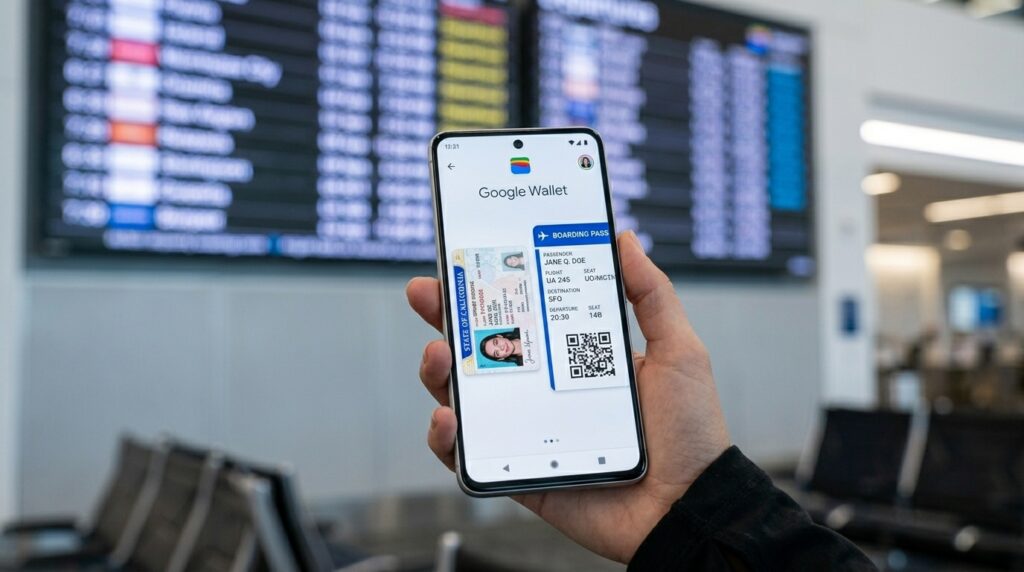
How Does Airport Security Operate?
It’s a fairly easy process.
Here’s how passengers use Google Wallet at TSA checkpoints that accept it:
First, unlock your phone.
Launch Google Wallet.
Choose Your Digital ID in Step Two
Select your state ID or driver’s license that has been stored.
Step 3: Scan or Tap
Depending on the airport, you’ll either
Press your phone.
Examine a QR code
Make use of NFC authentication
Step 4: Confirm Your Identity
To verify your identity, you’ll use:
A fingerprint
Face Unlock PIN
Step 5: Only Required Information Is Received by TSA
The TSA system only receives the data needed for identification verification, not your complete ID.
This privacy-focused strategy reduces needless data exchange.
Which airports accept Google Wallet IDs?
At the moment, not all airports accept digital IDs.
The initiative is being progressively expanded throughout participating airports in the United States by the Transportation Security Administration (TSA).
Particularly at bigger international airports, support keeps expanding.
Before depending entirely on a digital ID, travellers should always confirm airport compatibility.
Which States Now Allow Digital IDs?
Currently, only a few states in the United States offer digital identification cards or driver’s licenses that are compatible.
As more state governments implement digital identity initiatives, support is growing.
Examples consist of:
Arizona, California, Colorado, Georgia, and Maryland
In the upcoming years, more states are anticipated to join.
Google Wallet ID-Supporting Devices
In order to utilise a digital ID, users often require:
An Android mobile device
Installed Google Wallet
NFC-enabled
The most recent Android updates
An authorised digital ID from the state
Some features might not be supported by older Android smartphones.
Google Wallet: Is It Safe?
One of the main issues with digitally storing identification is security.
Thankfully, Google employs several security tiers.
Among them are:
Encryption of Devices
On your phone, your ID is still encrypted.
Biometric Verification
Your digital ID can only be accessed by you using:
Fingerprint PIN Face Unlock Restricted Data Exchange
Only the data required for identity verification is shared by Google Wallet.
Not all of the information on your ID is immediately sent to airport security.
Safe Hardware
Sensitive data is protected by secure hardware chips included in modern Android phones.
Google Wallet’s Advantages for Airport Security
There are various benefits to using a digital ID.
- Quicker Security Inspections
You no longer have to look for your driver’s license in your wallet.
You can access everything on your phone.
- Reduced Interaction
Digital verification minimises the need to handle IDs in person.
As a result, the screening procedure runs more smoothly.
- Enhanced Confidentiality
Only the necessary information is transmitted, rather than your entire ID.
- Easy Travel
Smartphones are already carried by the majority of travellers.
You’ll be carrying one fewer tangible object when you add your ID.
- Lower Chance of ID Loss
When travelling, physical IDs are readily lost.
You may always access a digitally stored version on your phone.
Potential Limitations
Although the feature is great, there are still a few issues with it.
Limited Availability
Currently, only participating airports accept Google Wallet IDs.
State Restrictions
Not every state offers appropriate digital IDs.
Reliance on Batteries
If your phone’s battery goes out, it becomes difficult to access your digital ID.
Backup May Still Be Required
Airport staff may still request to see your real ID in certain circumstances.
Just Android
Google Wallet digital IDs are currently only compatible with Android devices.
Do You Need a Physical ID to Travel?
One of the most common queries from tourists is this one.
The response is:
Not all the time.
The TSA advises bringing a physical driver’s license or passport as a backup, even if your airport accepts Google Wallet.
Physical identification may still be necessary due to technological malfunctions, airport regulations, or further identity verification.
How to Use Google Wallet with Your ID
Usually, adding your ID entails the following steps:
Launch Google Wallet.
Click “Add to Wallet.”
Select the ID card.
Choose the state in which you are issuing.
Scan your physical ID on both sides.
Full facial recognition.
Await approval.
Depending on the issuing authority, different approval times apply.
Features of Privacy
Google prioritises user privacy all the way through the verification process.
Among the privacy safeguards are:
Storage that is encrypted
Consent from the user prior to sharing
Biometric verification
Very little data transfer
Safe identity confirmation
Users have more control over the information they reveal than when they give out a physical ID.
Advice Prior to Travelling
Take into account these suggestions to prevent issues with airport security:
Make sure your phone is fully charged.
Google Wallet should be updated.
Turn on screen lock.
As a backup, keep your actual ID.
Check for compatibility with the airport.
Verify whether digital IDs are accepted in your state.
Benefits and Drawbacks of Google Wallet Rather than a Physical ID
Advantages/Disadvantages
Quicker airport check-inLimited access to airports
Only in a few states is enhanced privacy supported.
Safe biometric defenceDependency on phone batteries
Reduced chance of ID loss Physical identification might still be needed
Easy digital travelCompatibility with Android is necessary
There could be technical problems with contactless verification.
FAQ
- Can I use Google Wallet in place of my physical ID?
No. Carrying a physical ID is still advised, even if some airports allow digital IDs.
- Does every airport accept Google Wallet?
No, digital IDs are presently only supported at participating TSA checkpoints.
- Can passports be used with Google Wallet?
Digital IDs issued by the state are the main types of digital IDs that Google Wallet supports. Depending on the features and programs that are available, passport support varies.
- Is my data kept safe?
Indeed. Google employs robust hardware protection, biometric authentication, and encryption.
- What happens if the battery on my phone runs out?
Your digital ID won’t be accessible to you. For this reason, it’s still crucial to have a physical ID.
- Can Google Wallet IDs be used by iPhone users?
The feature is intended for Google Wallet-capable Android devices. When accessible, Apple’s ecosystem offers distinct digital ID solutions for iPhone users.
- Is it quicker to use Google Wallet than to present a physical ID?
Yes, most of the time. Identity checks can be expedited and made more convenient using digital verification.
- Is the internet necessary?
Although setup and upgrades may require connectivity, your stored digital ID can typically be accessible without an active internet connection.
Concluding Remarks
Another significant step toward completely digital travel is Google Wallet’s digital ID feature. The process is made quicker, more private, and much more convenient by enabling travellers to use a smartphone to confirm their identity at participating airport security checkpoints.
The technology is still developing, though. Travellers should keep their physical identification on hand as a backup until digital acceptance spreads because not all airports, states, or Android devices presently enable digital IDs.
Mobile IDs will probably become a common feature of air travel in the coming years as more airports and government organisations implement digital identity systems. Frequent travellers can already enjoy a more seamless airport experience while protecting their personal information by adding a compatible ID to Google Wallet.